Digital cap table
Take control of your ownership data with a digital cap table
Streamline share transfers, share issues, and ownership management in one dedicated platform.
Get started for free in minutes and use our step-by-step guides to manage everything from ownership changes to complex share issues with confidence. As soon as you register your share ledger or an event, your cap table updates automatically.
More than 30,000 limited companies have simplified their administration by using Sweden’s leading service for share ledger and cap table management


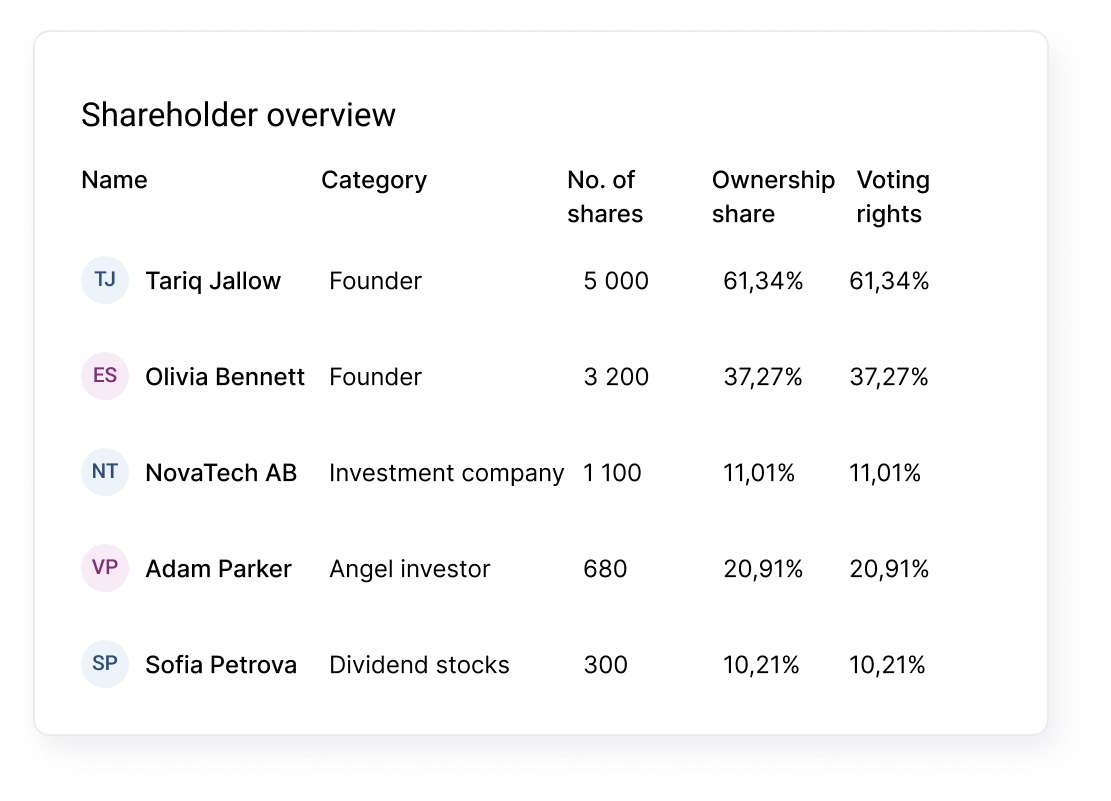
Complete overview
See exactly who owns what and how much with all ownership data in one place
Filter by owner type and view full details for each holding, including size, voting rights, restrictions, and share number
With NVR, you can easily see:
Number of shareholders
A full list of the company’s ownership, broken down by individual shareholder.
Ownership share, voting rights, and voting distribution
A clear summary of how ownership and voting rights are distributed across the company.
Capital structure
Share classes, restrictions, issued options, and more.
Owner updates
Automatically updated whenever new events are registered.
Shareholder Information
Synchronised data from the Swedish Companies Registration Office.
Owner type
Create your custom tags to easily identify whether an owner is a business angel, company, founder, or employee – and at which stage they invested.
History
View all ownership changes, share issues, and other events that have historically affected the share ledger and the company’s capital.
Why do I need a share ledger?
The simplest way to stay prepared for upcoming capital rounds and due diligence
Keep your share ledger up to date, and your cap table is ready for the board and investors at any time.

Digital share register with automatic calculations
Register an event in the share ledger and your cap table updates automatically
NVR’s digital share ledger makes it easy to manage complex transactions for companies of all sizes.

Automatic calculations
When you register an event in the share ledger, values such as valuations and quota value are calculated automatically, instantly updating your cap table and reports.

Share issues, stock splits, and other events
Even complex events are easy to register. The platform ensures that all input is correct.

Built-in error control
The product is designed to prevent errors when updating your share ledger, regardless of how complex the event is. The platform also notifies you if anything needs to be corrected.

Automatically generated settlement notes for share transfers
When a share transfer is registered, a settlement note is automatically generated for the buyer and seller and made available digitally within the platform.

Updated for all companies and shareholders
With a cloud-based digital service, all shareholders are notified instantly when events affecting them are registered.
Contact us
Something more complex? We set up your share ledger and handle all registrations for you
Share transfers, share issues, and share ledger events
NVR’s digital share ledger handles all types of events
NVR has been developed to cover every scenario that can affect the share ledger. Here are some of the most common events we handle with ease:

Simple share transfer
A seller and a buyer
Complex transfer
One buyer to many sellers, many sellers to one buyer, or many buyers to many sellers
New share issue
The company issues new shares by raising new capital from existing or new shareholders.
Non-cash issue
The company issues new shares in exchange for non-cash contributions from existing or new shareholders.
Bonus issue
The company increases its share capital without shareholders raising new capital, either by issuing new shares or by increasing the quota value.
Stock split
The company increases the number of shares by dividing a share into two or more shares with a lower quota value.
Reverse stock split
The company reduces the number of shares by merging two or more shares into fewer shares with a higher quota value.
Pre-emption clause and restrictions
A decision has been made to limit the transfer of shares or share classes through a pre-emption clause or other restrictions.
Share reclassification
All or individual shares are reclassified from one share class to another.
Reduction of share capital
Reduction of share capital can be carried out with or without withdrawal of shares.
Share certificates
Manage issue/cancellation of share certificates.
Dividend paid to another person
Add/remove share dividends paid to another person.
Notes
Add/remove notes.
Pledge of shares
Add/remove pledge of shares in the share ledger.
FAQs
What is a cap table?
A cap table, short for capitalisation table, is a snapshot of ownership in a private company. It is not the same as a share ledger. Instead, it reflects the outcome of all ownership-related events at a given point in time. In simple terms, a cap table shows the current ownership position, while the share ledger provides the legal history that leads to that position. Many companies believe they have control of their current ownership structure – but without a properly maintained share ledger, that “current view” has no solid legal foundation.
A cap table includes, among other things, a list of all shareholders in a company and how much each one owns. The share ledger, on the other hand, is governed in both its content and process by the Swedish Companies Act. The primary purpose of the share ledger is essentially to ensure traceability of the company’s ownership, whereas a cap table provides a snapshot overview of the current ownership structure and the rights associated with a specific holding.
What must a cap table include?
There are no statutory formal requirements for a cap table itself. It is a practical output derived from a correctly maintained share ledger and provides a clear overview of the company’s current ownership. A cap table is needed, among other things, to determine voting rights at a general meeting, distribute dividends, and allocate proceeds in the event of a sale. Therefore, a properly maintained share ledger is required – regardless of how you intend to use your cap table.
How do I set up a cap table?
It’s simple: establish and maintain a correct share ledger, and NVR automatically generates an accurate cap table. You can read more about how to create a legally compliant share ledger here.
What our customers think
This is what some of our customers have to say about the NVR platform.