

AMLR 2027: what changes and what must your company do?

“What does AMLR mean for us?” It is one of the questions Henrik Kristensen, founder of NVR, most often hears banks and accounting firms discussing right now. The short answer: from 10 July 2027, the same Know Your Customer (KYC) rules apply across the EU, and companies must keep the details of their beneficial owners accurate and up to date. The date falls in the middle of the summer holidays, so in practice your procedures and customer files need to be ready before the summer. Here we walk through what the rules mean and how banks, accounting firms and their customers can prepare.
AMLR at a glance
- What: the EU Anti-Money Laundering Regulation, Regulation (EU) 2024/1624. It applies directly in Sweden.
- When: applies from 10 July 2027.
- Who: banks, accounting firms, auditors and other obliged entities directly. Their customers indirectly.
- Beneficial owner: the threshold becomes 25 per cent or more, and indirect holdings are added together along the whole ownership chain.
- KYC: updated at least every year for higher-risk customers and at least every five years for all others.
What is AMLR and when does it apply in Sweden?
AMLR is the EU’s new Anti-Money Laundering Regulation. It mainly applies in Sweden from 10 July 2027. Under AMLR Article 1, the regulation sets common rules on how obliged entities combat money laundering and terrorist financing, on transparency of beneficial ownership and on measures against anonymous instruments.
An EU regulation applies directly in every member state. Sweden therefore does not need to transpose AMLR into Swedish law first. The package does, however, include AMLD6, the EU’s sixth Anti-Money Laundering Directive, which must be transposed into Swedish law. Some parts of the directive, including the rules on access to the beneficial ownership register, have earlier deadlines.
AMLR entered into force on 9 July 2024, but entry into force is not the same as application. For football agents and professional football clubs, the rules apply only from 10 July 2029, under Article 90.
The package also includes AMLA, the EU’s new anti-money laundering authority. AMLA will coordinate and harmonise the national supervisors and, in 2028, begin directly supervising selected financial institutions. Several of the technical standards and guidelines AMLA is drawing up to specify the requirements are not yet final, according to a review by Lindahl.

Who is affected by AMLR?
AMLR directly affects banks, financial institutions and several professions, including auditors and external accountants. Many other companies are affected indirectly, when these entities review their customers’ ownership and risk.
The regulation calls them obliged entities. In Swedish practice they are usually called verksamhetsutövare. AMLR Article 3 lists which entities are covered. Some tax advisers, lawyers and estate agents are also covered, depending on the services they provide.
An ordinary limited company does not become an obliged entity just because it is a bank customer. But Swedish companies already have to identify and report their beneficial owner under the Swedish Act on the Registration of Beneficial Owners. AMLR Article 63 also requires legal entities to keep the information adequate, accurate and up to date, with exemptions in Article 65.
Take an unlisted company that applies for a bank account and is owned through two holding companies. The bank needs to understand which natural persons ultimately own or control the company, so it may ask for a description of the ownership chain and documents that support it. Which documents are needed depends on the company’s structure and risk.
That is why companies outside the regulated sectors also need to be able to give their bank or accounting firm clear, current ownership details.
What changes for beneficial owners under AMLR?
AMLR makes the assessment of the beneficial owner, meaning the natural person who ultimately owns or controls a company, more uniform across the EU. In Sweden, the duty to identify and report the beneficial owner is already established. Under Chapter 1, Section 4 of the Swedish Act on the Registration of Beneficial Owners, more than 25 per cent of the votes can mean ultimate control, and other forms of control also count.
AMLR’s basic threshold is 25 per cent or more of the shares, voting rights or other ownership interest. Exactly 25 per cent is therefore covered. Ownership and control by other means must be examined in parallel, not in sequence, under AMLR Articles 51–53. The EU may later set a lower threshold for particularly high-risk categories.
| Swedish law today | AMLR from 10 July 2027 | |
|---|---|---|
| Ownership threshold | More than 25 per cent of the votes | 25 per cent or more of shares, voting rights or other ownership interest |
| How the rules apply | Swedish law implementing EU directives | EU regulation that applies directly |
| Beneficial ownership register | The obliged entity must search the register | The register is checked in addition to the obliged entity’s own verification |
| Updating KYC | Ongoing, based on risk | Ongoing, and at the latest after 1 year for higher risk and after 5 years for all others |
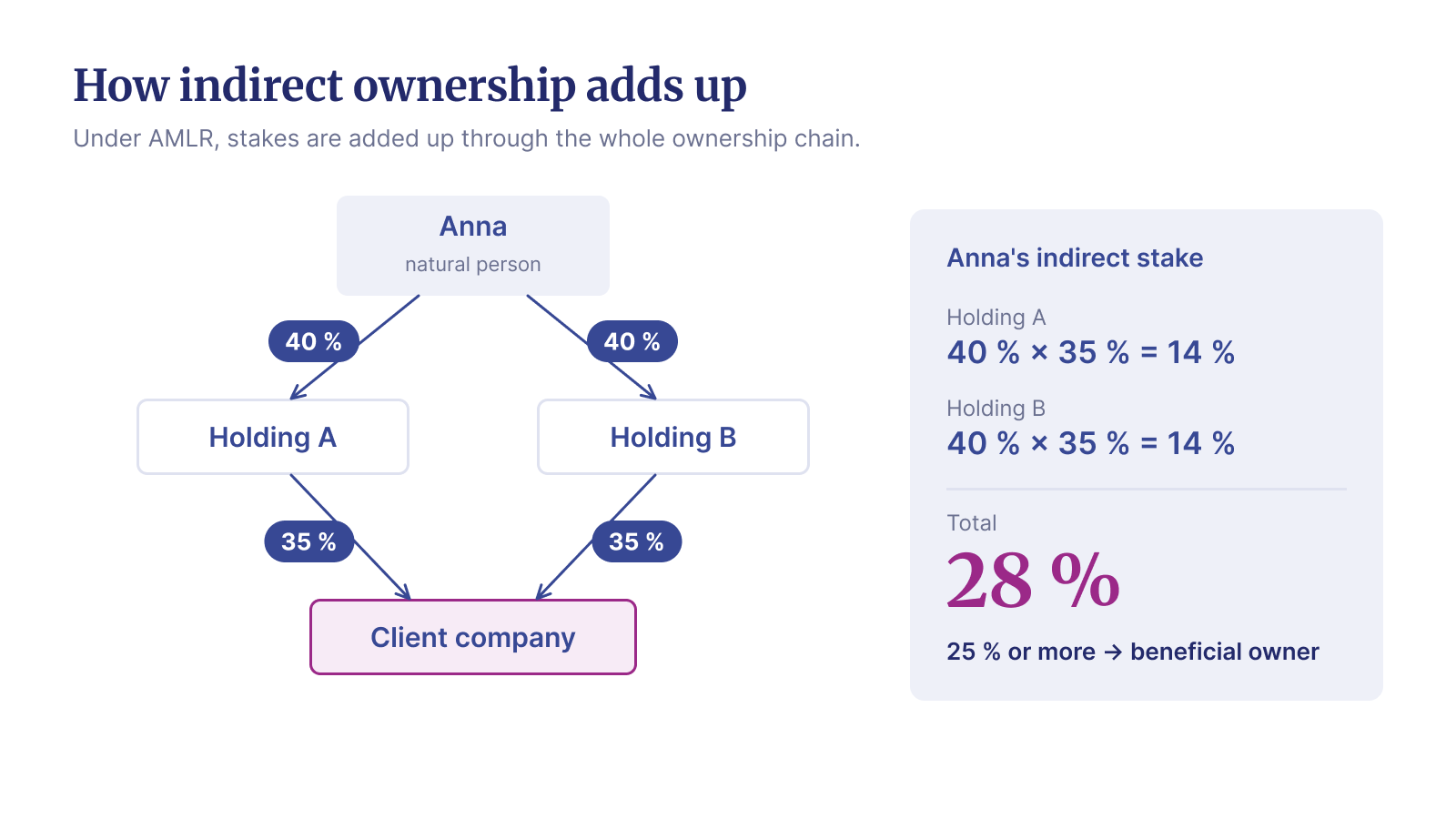
Where the same person owns through several chains, the shares of ownership are multiplied through each link and the results are added together. Anna owns 40 per cent each of Holding A and Holding B, which in turn each own 35 per cent of the customer company. Anna’s indirect ownership comes to 28 per cent, so she meets the threshold in Article 52. The example assumes that nobody has control through voting agreements, veto rights, the right to appoint the board or similar.
| Ownership chain | Calculation | Stake |
|---|---|---|
| Anna → Holding A → client company | 40% × 35% | 14% |
| Anna → Holding B → client company | 40% × 35% | 14% |
| Anna's indirect stake | 28% | |
A company keeps its own share ledger. The beneficial ownership register held by Bolagsverket, the National Companies House, is based on information that companies report themselves. It is neither a share ledger nor a check that the report matches actual ownership. Obliged entities already have to identify the customer’s ownership and control under Chapter 3, Section 8 of the Swedish Anti-Money Laundering Act (penningtvättslagen), and AMLR Article 22(7) clarifies that the register must be checked in addition to the entity’s own verification.
“The question is not what data we have collected, but why we can trust it.”
Henrik Kristensen has reviewed thousands of share ledgers over the years. Here is how he sees AMLR and beneficial owners.
When I review an ownership structure, I start with the share ledger, not the beneficial ownership register. Nine out of ten share ledgers I have reviewed that were kept in Word, Excel or PDF contained errors. That is my experience, not statistics for all Swedish companies.
Errors in the share ledger easily turn into errors in the beneficial owner assessment. I have seen indirect holdings calculated wrongly and share transfers that were never registered in the beneficial ownership register. A registered name is therefore not the same as a verified ownership chain.
If the share ledger, the agreements and the registered information say different things, the differences need to be resolved. More documents do not fix the problem if they contradict each other.
Information can go out of date between two checks. The aim should not be to collect as much as possible, but to be able to justify why the documents are enough for the risk assessment at hand.
Example: the share transfer that was never entered in the share ledger
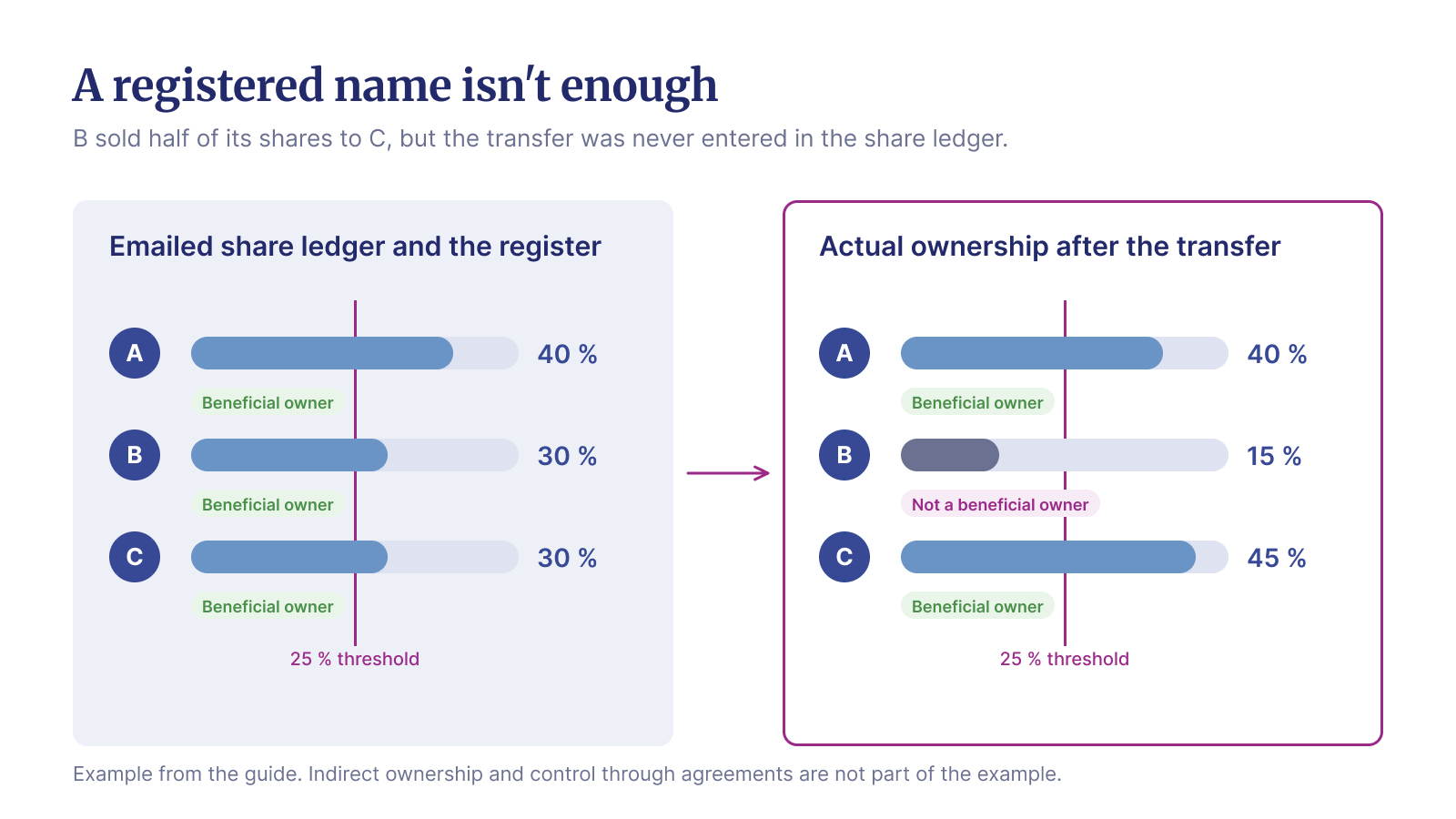
An unlisted company is owned by A (40 per cent), B (30 per cent) and C (30 per cent). B sells half of their shares to C. After the deal, A owns 40 per cent, B 15 per cent and C 45 per cent. A year later, the company applies for credit and the bank asks for the share ledger.
Why it went wrong
The transfer was made by agreement but never entered in the share ledger. The company emailed the Excel file it had saved, and it still showed the ownership split from before the deal. The report to the beneficial ownership register had not been updated either.
What it led to
- The wrong beneficial owner in the bank’s file. B was treated as a beneficial owner even though B owns only 15 per cent.
- Incorrect information in Bolagsverket’s register. The register showed B, who no longer meets the threshold.
- Follow-up requests and a delayed credit assessment. The bank had to ask for new documents and investigate the differences before the case could move on.
Three tips ahead of July 2027
- Check the share ledger and the documents behind every change.
- Follow the whole ownership chain, all the way up to the natural persons.
- Introduce a routine that keeps the information current between checks.
How does AMLR change KYC?
Under AMLR, the same KYC rules apply across the EU. Ongoing monitoring is not new in Sweden, though: Chapter 3, Section 13 of the Swedish Anti-Money Laundering Act already requires business relationships to be monitored and KYC to be kept up to date.
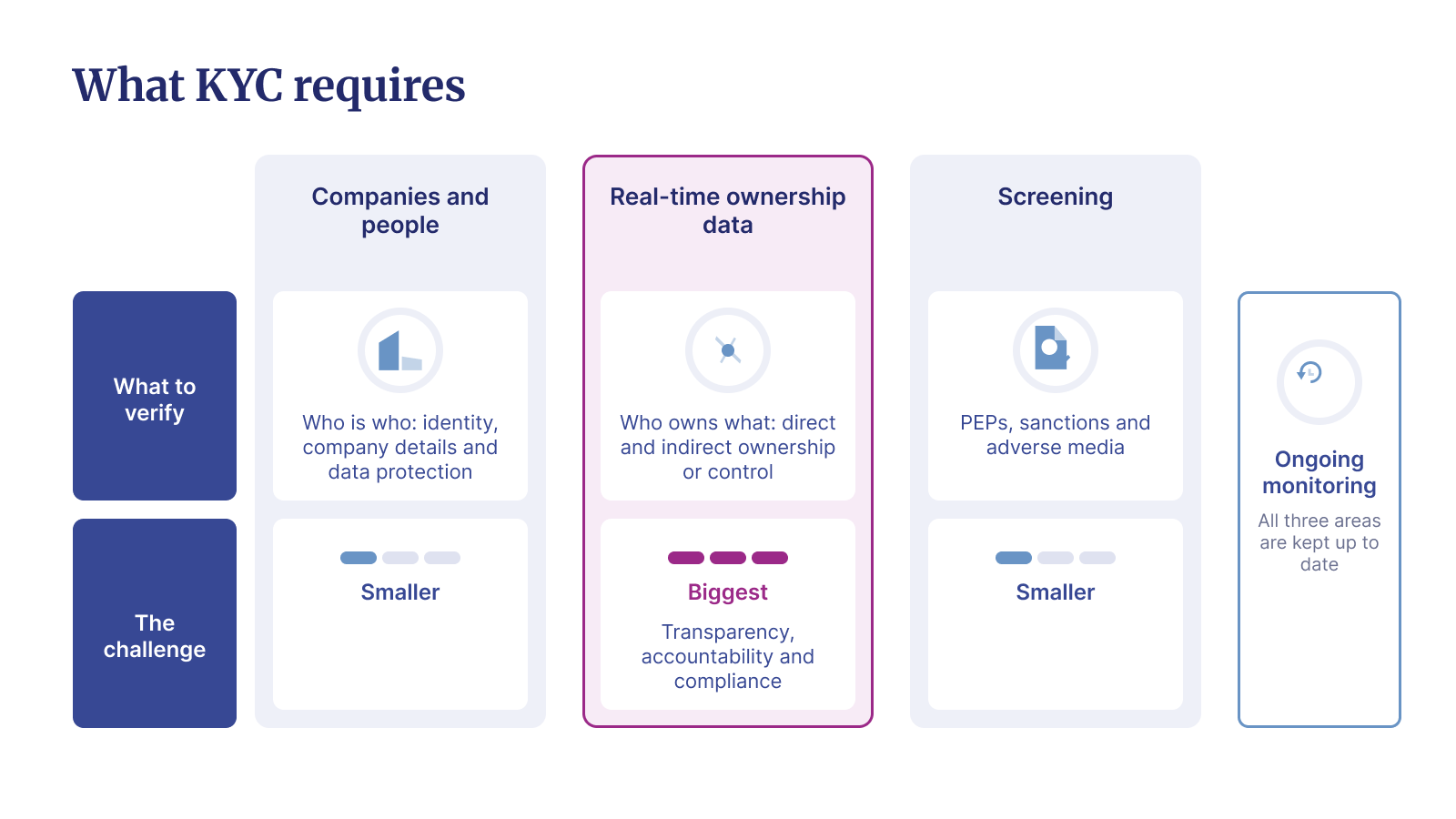
KYC, short for Know Your Customer, means that the obliged entity identifies the customer and verifies the customer’s identity. It must also identify the beneficial owners, take reasonable measures to verify their identity and understand the customer’s ownership and control structure. This includes the purpose of the business relationship and ongoing monitoring of the customer’s transactions, under AMLR Article 20.
How extensive the checks must be depends on a risk assessment of each customer. AMLR allows simplified due diligence measures for lower risk and requires enhanced due diligence measures for higher risk, under Articles 33 and 34. Low risk therefore does not mean KYC can be skipped.
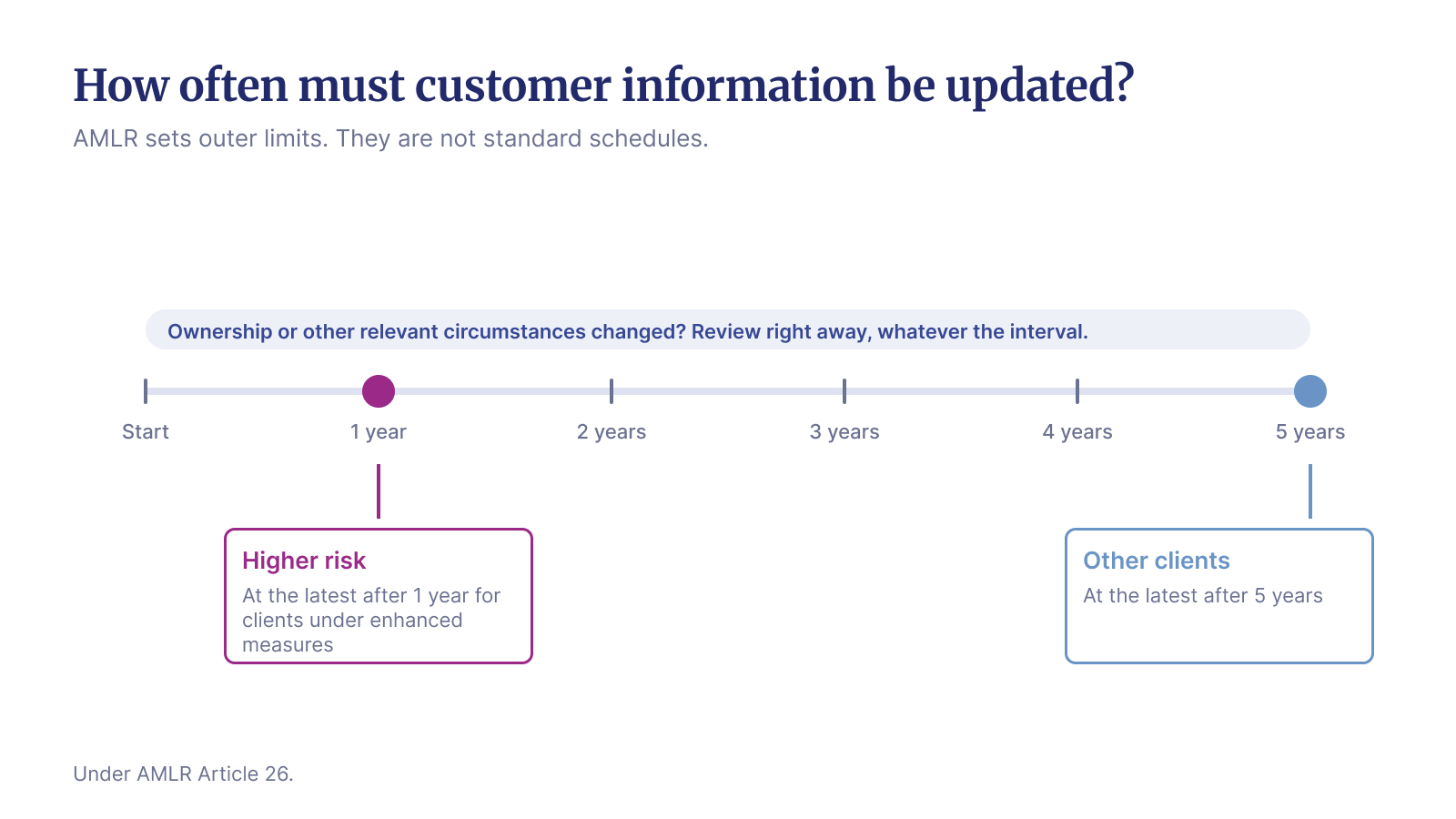
The information must be updated at least once a year for higher-risk customers subject to enhanced due diligence measures, and at least every five years for all other customers, under Article 26. These are outer limits, not standard schedules. If relevant circumstances change, the information must be reviewed sooner. A new owner can therefore call for a fresh review of the ownership chain and the customer’s risk profile.
What must banks and accounting firms do to prepare for AMLR?
Banks and accounting firms need to compare their current ways of working with AMLR and close any gaps in good time. Start with the customer base, the risk assessment and the KYC procedures. The requirements for internal procedures and the business-wide risk assessment are in AMLR Articles 9 and 10.
What should the bank prioritise?
Map where customer information and ownership documents are incomplete or hard to verify. Prioritise by risk, for example complicated ownership structures. Decide which documents are needed to understand the ownership and how to handle conflicting information.
Then review the division of responsibility between relationship managers, KYC teams and compliance. Who assesses a changed ownership chain, requests additional information and follows up the answers? Check that the systems can meet the update requirements in Article 26 and that assessments can be traced afterwards. Finansinspektionen, the Swedish Financial Supervisory Authority, supervises banks’ anti-money laundering work.
What should the accounting firm prioritise?
Start from the firm’s actual customers and services. A generic template is no substitute for a risk assessment tailored to the business. Srf konsulterna, the association of Swedish accounting and payroll consultants, already stresses a risk-based approach, documented procedures and KYC.
Decide how staff should handle changes they find during engagements, such as new owners or new representatives. Responsibility must be clear even when a consultant has known the customer for years. The county administrative boards (länsstyrelserna) supervise accounting firms’ anti-money laundering work.
When access to the beneficial ownership register is limited to those with a legitimate interest, accounting firms and auditors will generally count among them, according to FAR, the institute for the accountancy profession in Sweden.
How do you choose data sources and follow up?
Assess the reliability, timeliness and coverage of data sources, not just how quickly the information can be retrieved. Test the procedures on a few customer cases and document what needs to improve. Assign clear responsibility and train the staff concerned. AMLR Article 12 requires ongoing training tailored to roles and risks.
How do you verify ownership structure and beneficial owners?
You verify ownership structure and beneficial owners by checking ownership and control, following the ownership chain and confirming the identity of the beneficial owners. The beneficial ownership register is one of the sources, not the whole check.
Start with current share ledgers and other relevant documents for the companies in the ownership chain. Check shares of ownership, voting rights and agreements that affect control. Document which information was used and resolve the differences between the documents.
A share ledger in Word or Excel can be correct, but its quality depends on how it is kept and checked. When files are sent by email, the recipient needs to know which version applies and what has changed. A PDF shows the position at one point in time, not whether later ownership events have been included.
Suppose the bank receives a share ledger by email, but the company then registers a new share issue or a share transfer, or completes a stock option program. The file that was sent still shows the old ownership split. A structured service can update the calculations when the changes are registered, but the recipient still needs to use current information.
What sets a structured share ledger service apart is the way of working, not just that the data is digital. Registered events can be linked to calculations, checks and history. An API, meaning an interface between systems, can transfer structured data continuously, without documents first having to be sent and interpreted.
How do you get current, verifiable ownership data?
NVR’s digital share ledger has built-in validation, automatic calculations and saved history whenever ownership events are registered. The service is API-driven and provides structured data for ongoing review of ownership data. The data is never more current than what the company registers, and by law the responsibility for keeping the share ledger stays with the company. Access to the data also needs to be managed.
Neither a digital service nor an API replaces the bank’s or accounting firm’s own assessment. What matters is being able to trace the information back to its source documents and judge whether the checks are enough for the customer’s risk.
Common misconceptions about AMLR
These are the misconceptions we meet most often when AMLR comes up.
“It’s enough that the beneficial owner is registered.”
No. The register is a checkpoint, but the bank or accounting firm must also verify identity and understand the ownership and control structure.
“AMLR only applies to banks.”
No. AMLR Article 3 covers accounting firms, auditors and certain legal services, among others. Ordinary companies also have their own duty to keep the details of their beneficial owners up to date, under Article 63.
“We can start preparing in summer 2027.”
That is too late. Banks and accounting firms must meet the requirements from day one, so customer files, responsibilities and systems need to be reviewed before then. Gaps in today’s KYC must also be dealt with now, under the current rules.
“KYC is done when the customer comes in.”
No. The initial check is not enough to carry you through until the customer next gets in touch. AMLR Article 26 requires ongoing monitoring and up-to-date customer information, and relevant changes may call for a review before the next scheduled update. Ongoing monitoring is already required under Swedish law today.
“More collected documents mean better KYC.”
No, the quality of the content is what counts. Ask three questions:
- Is the information verified?
- Can it be cross-checked against other sources?
- How do we get access to information that is kept continuously up to date?
Checklist: how to prepare for AMLR 2027
Map the gaps in your KYC and draw up a time-bound plan to close them before 10 July 2027. For banks and accounting firms, these eight steps are a practical starting point:
- Assign responsibility. Decide who leads the preparations, makes decisions and follows up that gaps are closed.
- Map the customer base. Find incomplete information and prioritise by risk, for example complex ownership structures.
- Review the risk assessment. Tailor it to the business’s actual customers, services, geographic exposure and ways of working.
- Check the ownership documents. Make sure share ledgers, ownership chains and information on control are current and can be reviewed.
- Review the data sources. Assess reliability, timeliness and coverage, and decide how conflicting information will be investigated.
- Plan the updates. Set intervals according to risk and create routines that catch changes in between.
- Train your staff. Explain which checks they are responsible for, which documents are needed and when to escalate questions.
- Test the whole process. Follow a few customer cases from collection to documented assessment. Fix the gaps and follow up on the results.
The checklist is an aid to preparation, not a complete list of the regulation’s requirements.
Frequently asked questions about AMLR
These are the questions we get asked most often about AMLR.
Does AMLR apply to my company?
It depends on the business and on which obligation is in question. Banks, accounting firms and other obliged entities are subject to requirements on KYC, among other things, under AMLR Article 3. Other companies also have their own obligations regarding their beneficial owners under Article 63, with exemptions in Article 65.
Does AMLR replace the Swedish Anti-Money Laundering Act?
Partly. AMLR takes over large parts of today’s preventive rules, but Swedish rules are still needed. AMLD6 requires national provisions on supervision and registers, among other things.
What is AMLA?
AMLA is the EU’s new authority for combating money laundering and terrorist financing. It coordinates the national authorities and is meant to help ensure the rules are applied equally across the EU. From 2028, AMLA will directly supervise selected financial institutions, not all companies covered by AMLR.
Do we need to review our registered beneficial owner?
Yes. Changed definitions and information requirements in AMLR Articles 52, 62 and 63 may mean the information needs to be supplemented. Distinguish between updating information and making a new registration, and follow Bolagsverket’s instructions.
Why does the bank ask again when we have already reported our beneficial owner?
Because a report to Bolagsverket does not replace the bank’s own checks, and Bolagsverket does not verify that the information is correct. The bank must verify the beneficial owner’s identity, check against the register, understand the ownership and control structure and keep the information up to date, under AMLR Article 22(7). That is why the bank can ask for additional information even when the beneficial owner is already registered.
What happens if we don’t meet the requirements?
It depends on which obligation and which shortcoming is concerned. An obliged entity that cannot complete KYC must as a general rule not enter into the business relationship, and must terminate an existing one, under AMLR Article 21. Shortcomings at the obliged entity can also lead to supervisory measures and sanctions.
Which share ledger should we send when we have several versions?
A company should have only one share ledger. Resolve the differences between the versions, then send the current share ledger. The most recently saved file is not automatically the right one, so check that all share transfers and company events have been entered. If the differences have not yet been resolved, tell the bank and agree which documents are needed.
AMLR makes KYC requirements the same across the EU and places clearer responsibility on companies to keep their beneficial owner information up to date. For banks and accounting firms, preparing means working on procedures, responsibilities and documents. For their customers, it means being able to show who owns the company and why the information is correct. It all starts in the share ledger.
The right share ledger gives the right basis for KYC.
NVR’s digital share ledger keeps ownership data accurate and traceable, and through NVR’s API the data can be pulled straight into the bank’s or accounting firm’s own systems.
See how NVR works – book a demo.
Sources
[1] Regulation (EU) 2024/1624 on the prevention of the use of the financial system for the purposes of money laundering or terrorist financing (AMLR) · eur-lex.europa.eu
[2] Directive (EU) 2024/1640, the sixth Anti-Money Laundering Directive (AMLD6) · eur-lex.europa.eu
[3] AMLA – About AMLA · amla.europa.eu
[4] Lindahl – Det nya AML-paketet: när kommer det och vad är status? (Swedish) · lindahl.se
[5] Lag (2017:631) om registrering av verkliga huvudmän (Swedish) · riksdagen.se
[6] Bolagsverket – Verklig huvudman (Swedish) · bolagsverket.se
[7] Lag (2017:630) om åtgärder mot penningtvätt och finansiering av terrorism (Swedish) · riksdagen.se
[8] Finansinspektionen – Regler mot penningtvätt och finansiering av terrorism (Swedish) · fi.se
[9] Srf konsulterna – Penningtvätt: regler och rutiner för byråer (Swedish) · srfkonsult.se
[10] FAR – EU:s nya penningtvättspaket: vad innebär reglerna för Sverige? (Swedish) · far.se